May
2026

Cutting Giants Down to Size

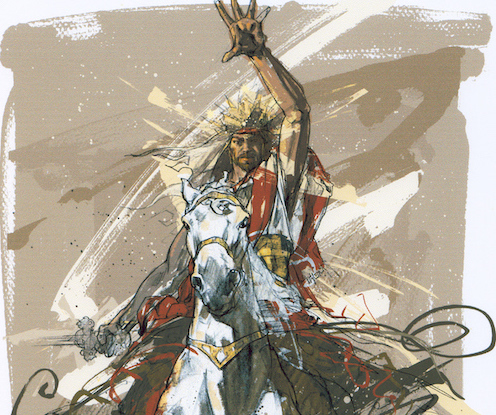
Title: David and Goliath [Click for larger image view]I was recently reminded of Christian novelist and essayist Frederick Buechner’s whimsical take on Goliath, from his book Peculiar Treasures:

GOLIATH STOOD 10 FEET TALL in his stocking feet, wore a size 20 collar, a 9 1/2 inch hat, and a 52-inch belt. When he put his full armor on, he looked like a Sherman tank. Even stripped to the bare essentials, he had plenty to carry around, and flesh and bones were the least of it. There was the burdensome business of having to defend his title against all comers. There were the mangled remains of the runners-up. When he tried to think something out, it was like struggling through a hip-deep bog. When he tried to explain something, it was like pushing a truck uphill. His dark moods were leaden and his light moods elephantine. He considered under-arm deodorants a sign of effeminacy.

The stone from David’s slingshot caught him between the eyes, and when he hit the dirt, windows rattled in their frames as far away as Ashkelon. The ringing in his ears drowned out the catcalls of the onlooking armies, and his vision was all but shot, but he could still see enough to make out the naked figure of a boy running toward him through the scrub. His hair streamed out behind him like copper, and he was as swift and light-footed as a deer.

As he straddled Goliath with Goliath’s sword in his hand, the giant believed that what he was seeing was his own soul stripped of the unwieldy flesh at last for its journey to paradise, and when David presented the severed head to Saul later, there was an unmistakable smile on its great lips.

The painting above by folk artist John August Swanson is the way that I recall this scene from my childhood Bible story books.  Goliath is a fairy-tale giant, inhumanly massive.  Little David’s defeat of this monster is a nothing short of a miracle: especially as David eschews armor and weaponry, facing the giant with only his shepherd’s sling and five smooth stones.  That is how we retell the story.  But what does the Bible say?  Just how big was Goliath, anyway?

You’ll find the biblical account of David and Goliath in 1 Samuel 17.  In the old King James Bible, where I first read this story, his “height was six cubits and a span” (1 Samuel 17:4; see also the RSV, the NRSV, the NIV, and the ESV)–a literal rendering of shesh ‘ammot wazareth in the Hebrew Masoretic Text (or MT: the text used in the synagogue, on which our Old Testament is based).  The Hebrew units were originally rules of thumb: a cubit is the distance from your elbow to the tip of your middle finger; a span is the width of your outstretched hand, from the tip of your thumb to the tip of your little finger–or, as you can check for yourself, about half a cubit.

According to The Hebrew and Aramaic Lexicon of the Old Testament, the standard cubit was about a foot and eight inches (50 cm), and the span about ten inches (25 cm), making Goliath (as Buechner wrote) over ten feet tall!  The CEB (and text critic P. Kyle McCarter in his HarperCollins Study Bible footnotes) presume a more conservative reckoning: “he was more than nine feet tall.”  Now, that is big, to be sure, but it isn’t fairy-tale big: Goliath was not 25 feet tall, or 50 feet tall.  He was much bigger than people usually get, but still a very big man, not a monster (although the marginal notes in one Latin text suggest that Goliath was sixteen cubits tall!).

Intriguingly, the Septuagint–the translation of Jewish Scripture into Greek from north Africa, in the century or two before Jesus’ birth–says that Goliath’s height was four cubits and a span, or (according to McCarter and the CEB footnotes), over six feet tall.  Now this is still big–particularly for late eleventh century BCE  Palestine (when even I–at just over five and a half feet–would have been taller than average!).  But it is scarcely gigantic: most pro basketball centers (who average seven feet) would be taller than Goliath!

The discovery of ancient Hebrew scrolls and text fragments hidden in caves at Qumran (commonly called the Dead Sea Scrolls) confirms that often, the Septuagint translators were working with different–and in many cases, older and better–texts of those books.  This is particularly the case with Samuel, which seems to have been poorly preserved by the MT scribes.  One fragmentary Hebrew text of Samuel, found in Cave Four (4QSama), is now the oldest and best text of Samuel available.  In 1 Samuel 17:4, 4QSama also has four cubits and a span–which is the way the text reads in the recently revised NRSVue.

So, if Goliath was not a giant, why was no one in Saul’s army willing to face him?  The text tells us why: Goliath was ‘ish-habbanayim–“the man who stands between.”  In other words, going out alone between combatting forces, to face and defeat the ish-habbanayim of his enemies in single combat, was Goliath’s job.  That he was still alive, and famous, means that he was very good at his job.  Goliath was a dangerous, well-trained, and well-armed professional killer.

To us, this still may sound like a fairy tale: would any army really rely on single combat to determine which side would prevail?  However, other clan-based cultures did use such contests to resolve their differences.  The Celts, in particular, sometimes settled disputes over property or territory not only by single combat, but by non-lethal contests between bards involving song, poetry, and insults! Such resolutions would be far more economical than pitched battles, with their loss of life and destruction of property.

The description of Goliath’s armor and weaponry (1 Sam 17:4-7) tells us much, both about the culture of the times, and this champion’s preferred fighting style:

He had a helmet of bronze on his head, and he was armed with a coat of mail; the weight of the coat was five thousand shekels of bronze.  He had greaves of bronze on his legs and a javelin of bronze slung between his shoulders.  The shaft of his spear was like a weaver’s beam, and his spear’s head weighed six hundred shekels of iron, and his shield-bearer went before him (NRSVue).

The mixture of bronze and iron in Goliath’s weaponry is a reminder of the Late Bronze-Early Iron Age context of this narrative.  The Philistines (unlike the Hebrews; see Judges 1:19) had mastered the working of iron, but it was still difficult, and expensive.  So only the fifteen-pound head of Goliath’s heavy, stabbing spear is made of that wonderful, armor-piercing metal; his armor (all 125 pounds of it!), and his throwing javelin, are bronze (intriguingly, his sword is not mentioned here).  That javelin, note, is Goliath’s only distance weapon–which makes sense, for a single fighter. Goliath counts on closing with his enemy, where his size and strength–and his armor-piercing spear–will make short work of any adversary.

David’s chosen tactic, then, makes good sense!  Being unarmored, he can move quickly: much more quickly than his heavily armored adversary.  Should Goliath opt to throw his javelin, David will be able to dodge.  Goliath, on the other hand, is anything but nimble: a scarcely-moving target for David’s sling stones.  David’s sling catches him in the forehead, just below his bronze helmet, and knocks him senseless–so that David can run up and decapitate the Philistine champion with Goliath’s own sword (1 Samuel 17:51).

Title: Tapestry of David slaying Goliath [Click for larger image view]

This is a different story than the one in my childhood Bible story book!  But I think it is a better one.  Retelling the story, we tend to heighten the marvelous and miraculous elements–something that the Bible sometimes does as well.  Some biblical traditions do claim that the Israelites faced giants in Canaan–monsters descended from the half-human, half-god Nephilim (Numbers 13:33; compare Genesis 6:4).

But the more human story revealed by the best text of Samuel does not in any way lessen God’s involvement and care.  If anything, it makes the encounter between David and Goliath more real: less a children’s story about “Bible times” and more a promise of God’s presence with us in our encounters with enemies that seem too strong to overcome: for example, our prevailing national sin of racism.

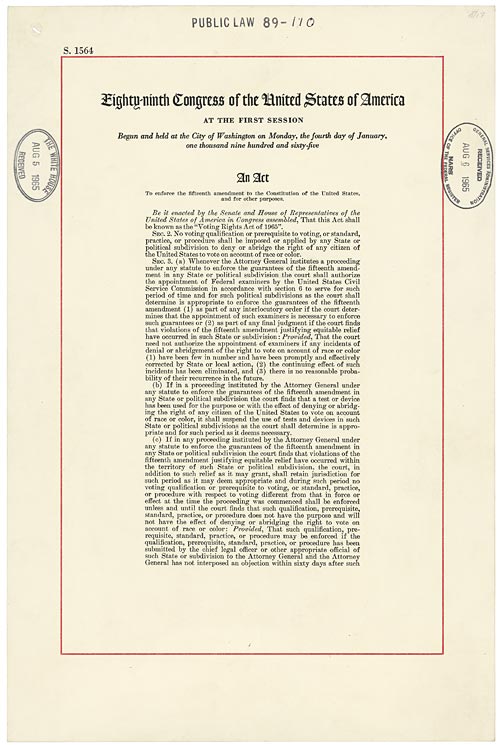
Last week, the U. S. Supreme Court overturned the key features of the 1965 Voting Rights Act.  The majority held that the Act had already served its purpose, and that going forward, “at least ‘a strong inference’ of discriminatory intent in the drawing of legislative lines”  is necessary “to prove that a map unfairly discriminates against minority voters.” So long as states say that their intention was not discriminatory, then, they are free to eliminate majority African American voting districts–as, indeed, Louisiana and Florida have hurried to do, before the next election cycle.  In her blistering dissent, Justice Elena Kagan wrote,

The Voting Rights Act is—or, now more accurately, was—“one of the most consequential, efficacious, and amply justified exercises of federal legislative power in our Nation’s history.” Shelby County, 570 U. S., at 562 (Ginsburg, J., dissenting). It was born of the literal blood of Union soldiers and civil rights marchers. It ushered in awe-inspiring change, bringing this Nation closer to fulfilling the ideals of democracy and racial equality. And it has been repeatedly, and overwhelmingly, reauthorized by the people’s representatives in Congress. Only they have the right to say it is no longer needed—not the Members of this Court. I dissent, then, from this latest chapter in the majority’s now-completed demolition of the Voting Rights Act.

Those struggling for racial justice and equity may be tempted to despair.  But the story of David and Goliath urges us to respond rather with a resolute hope. With David, we can say to our contemporary adversaries,

You are coming against me with sword, spear, and scimitar, but I come against you in the name of the LORD of heavenly forces, the God of Israel’s army . . . the whole world will know that there is a God on Israel’s side.  And all those gathered here will know that the LORD doesn’t save by means of sword and spear. The LORD owns this war, and he will hand all of you over to us (1 Samuel 17:45-47).

Whatever our battle, friends, whether against the besetting sins that threaten our personal spiritual walk, or against our national and cultural sins of racism, poverty, and injustice, we do not fight alone, or in vain.  God is with us, cutting those giants down to size.

Apr
2026

Vengeance?

I have just learned that Secretary of Defense Pete Hegseth, at the latest of the monthly Evangelical Protestant worship services he has instituted in the Pentagon,  led a prayer he called “CSAR 2517:” standing for, he said “Combat Search And Rescue,” and the Bible reference for the prayer, Ezekiel 25:17.  He then “prayed”:

The path of the righteous man is beset on all sides by the inequities of the selfish and the tyranny of evil men. Blessed is he who, in the name of charity and good will, shepherds the weak through the valley of darkness, for he is truly his brother’s keeper and the finder of lost children. And I will strike down upon thee with great vengeance and furious anger. And you will know my name is the Lord when I lay my vengeance upon thee.

If you followed the link above to Ezekiel 25:17 in the KJV (a translation whose cadences this prayer broadly imitates), you will know that Hegseth’s prayer did not, in truth, come from that passage, which simply reads, “And I will execute great vengeance upon them with furious rebukes; and they shall know that I am the LORD, when I shall lay my vengeance upon them.”  So, where does it come from?

Its author is not Ezekiel, as it turns out, but Quentin Tarantino; and it comes, not from any biblical translation, but from the 1994 film “Pulp Fiction” –where those lines are delivered by the inimitable Samuel L. Jackson, playing a hit man in the process of brutally executing an unarmed man.  Here is the movie scene, including the quote in context.

In his worship service, Mr. Hegseth said, “Fifteen minutes ago I was talking about blockades with Admiral Cooper, and now we’re going to study the Lord’s word. May what we talk about, how we worship today, inform the remainder of our day and the remainder of our week.”  So evidently, he actually believed that he was quoting Scripture.

As it happens, I have never seen “Pulp Fiction.”  But I do know a bit about the book of Ezekiel.  Not only does Mr. Hegseth’s “prayer” not come from this biblical book, but his use of Ezekiel 25:17 entirely distorts its actual meaning in its context.

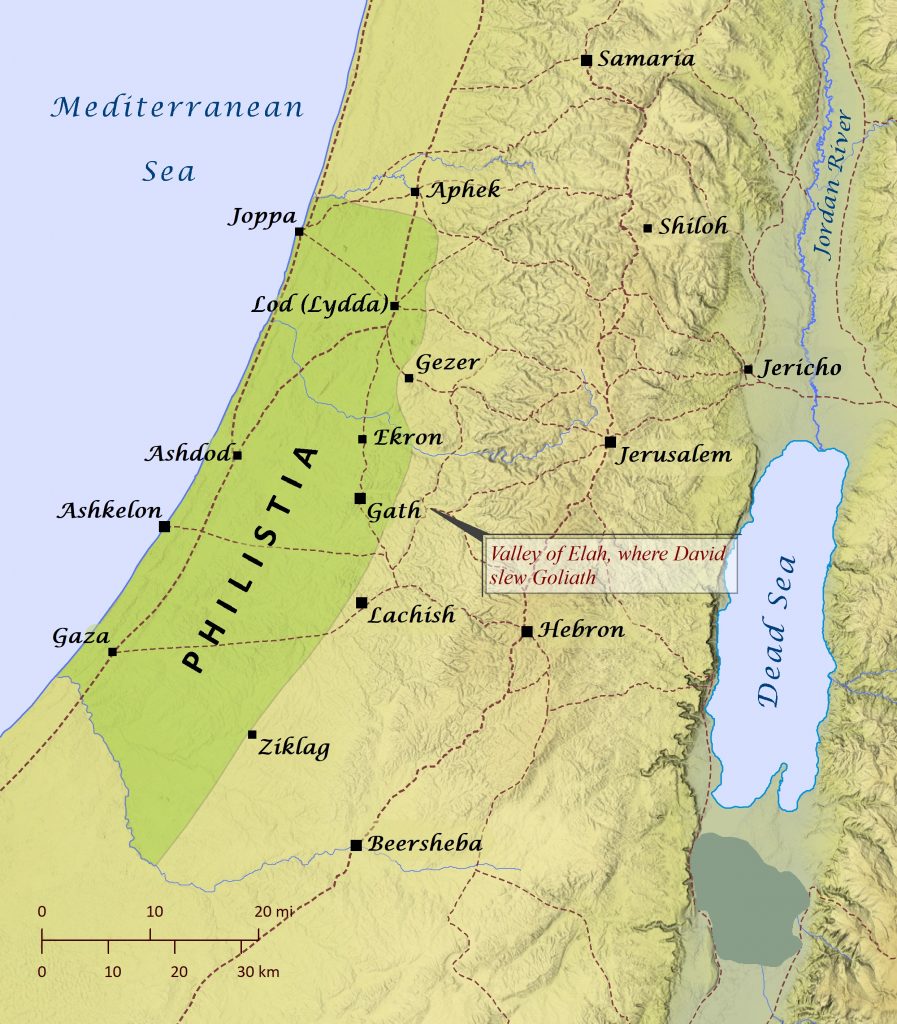
Ezekiel 25:15-17 is an oracle of the prophet against the Philistines.

The Lord GOD proclaims: When the Philistines set out to right the wrongs done to them, they enacted revenge with utter contempt and old hatreds.  So now the Lord GOD proclaims: I will overpower the Philistines, eliminate the Cherethites, and obliterate all who are left along the coastline.  I will act against them with great vengeance and with wrathful punishments. When I execute my vengeance against them, they will know that I am the LORD.

Oracles against foreign nations, like this one, were an important part of the prophetic repertoire.  Collections of such oracles commonly appear in prophetic books: we can compare Ezekiel 25—32 to Amos 1—2; Jeremiah 46—51; or Isaiah 13—23.   Ezekiel’s oracles against the nations consist of a series of short, pithy prophecies against Ammon (25:1-7), Moab (25:8-11), Edom (25:12-14), and Philistia (25:15-17); a collection of material regarding Tyre (26:1—28:19), another brief oracle, against Sidon (28:20-24); a promise of blessing upon Israel (28:25-26), and a miscellaneous collection concerning Egypt (29:1—32:32).

But it is doubtful that any of these messages were really meant to be read by foreigners, or indeed that any foreign king ever saw them.  Their intended audience was the people of Israel—just as, in our own day, political pronouncements about international affairs are often meant for domestic consumption.  So even in Ezekiel 25–32, where the subject of his oracles is other nations, Ezekiel is actually addressing his audience of Judeans in exile (as Ezekiel 28:25-26 makes plain).

The Philistines were a major group of the Aegean raiders called the Sea Peoples.  They settled along the southern coast of Palestine early in the twelfth century, and built a chain of five city-states: Gaza, Ashdod, Ashkelon, Ekron, and Gath.  Despite their warlike character, it is a mistake to think of the Philistines as uncultured brutes.  Archaeological investigations at the three Philistine sites known to us (Gaza, Ashdod, and Ashkelon) show the Philistines to have been an artistically accomplished, highly sophisticated people (Ekron might have been located at Tel Miqne, but the location of Gath remains entirely unknown).

The Philistines were major rivals of the Israelite tribes, but particularly of Judah; the Samson cycle (Judges 13—16) is largely concerned with Judah’s struggles against Philistine domination.  Although David forced the Philistines to acknowledge his hegemony (2 Samuel 8:1), Philistia remained a constant threat throughout the history of the monarchy.  In the eighth century BCE, Philistia was granted considerable autonomy within the Assyrian empire, since it served as an important bulwark for Assyria against Egypt.  Therefore, Hezekiah launched his rebellion against Assyria by seizing Philistine territory (2 Kings 18:8).  Likely, the Philistine vengeance to which Ezekiel refers in 25:15 came in the wake of Sennacherib’s suppression of that revolt, when the Philistines reasserted their control over the disputed lands (see Ezekiel 16:27).  In Ezekiel’s day, Philistia once more was a buffer state, this time standing for Egypt and against Babylon.  However, just as Ezekiel’s oracle affirms, Philistia’s days were numbered: like Judah, Philistia would be overrun by the Babylonians under Nebuchadnezzar and taken into exile.

The reason for God’s judgment against Philistia is stated in that first verse: “The Lord God proclaims: When the Philistines set out to right the wrongs done to them, they enacted revenge with utter contempt and old hatreds” (Ezekiel 25:15).  Like Edom, condemned in Ezekiel 25:12-14, Philistia is punished for taking vengeance.  Further, as in the Edom oracle, the punishment meted out against Philistia is the LORD’s direct vengeance, brought by the LORD’s own hand (compare Ezekiel 25:13 and 16)–and not, please note, by Israel.  In this way, “When I execute my vengeance against them, they [that is, the Philistines] will know that I am the LORD” (Ezekiel 25:17).

Apart from the specific context of family honor (see the various references to the go’el haddam [“avenger of blood”] in Numbers 35 and Deuteronomy 19), Torah rules out vengeance in the human world: “You must not take revenge nor hold a grudge against any of your people; instead, you must love your neighbor as yourself; I am the LORD” (Leviticus 19:18).  So, while Saul is condemned for seeking vengeance (1 Samuel 14:24), David is commended for leaving vengeance to God (1 Samuel 24:12).  Indeed, the LORD appears as go’el–that is, the avenger or the redeemer–in Exodus 6:6; Jeremiah 31:11; 50:34; Micah 4:10; Psalms 19:14 and 107:2; and 15 times in Second Isaiah (Isaiah 40-55; for example, Isaiah 41:14; 43:14; 48:17).  God takes vengeance directly against the nations, not only in Ezekiel 25:12, 15 but also in Genesis 4:15, 24 and Deuteronomy 32:43, acting on behalf of God’s own people, or for God’s own honor (Jeremiah 46:10). But often in Scripture, the Hebrew verb naqam (“take vengeance”) expresses God’s vengeance, not against foreigners, but against a sinful and rebellious Israel: in defense of the helpless, and on behalf of God’s own covenant and name (Leviticus 26:25; Isaiah 1:24; Jeremiah 5:9, 29; 9:9; 15:15; Ezekiel 24:8).

Edom and Philistia, having taken vengeance against Judah, are in turn consumed by the vengeance of God.  Their fate in Ezekiel 25 calls to mind a central theme of Israel’s wisdom literature: that violence and injustice carry within them their own consequences.  So, Proverbs 22:8 declares,

Those who sow injustice will harvest evil;
    the rod of their fury will come to an end.

Christian readers may be reminded of Jesus’ words to one who attempted to defend him from the mob in Gethsemane: “Put the sword back into its place. All those who use the sword will die by the sword” (Matthew 26:52).  Even if we disregard Tarantino’s grotesque ornamentation of this passage in “Pulp Fiction,” in no way does Ezekiel 25:17 justify our claims to wreak vengeance on God’s behalf.  Indeed, its point is quite the opposite: it is a warning against taking vengeance.  Here as throughout the Bible, the point is that vengeance belongs to God, not to us.  Certainly, this passage does not, as Secretary Hegseth implies, legitimate our war of aggression in Iran.


Apr
2026

Christe anesti!

In the early church, when sisters and brothers met one another in the holy season of Easter, they would not just say “Hello.”  Instead, they would greet one another with a hearty and enthusiastic Christe anesti–“Christ is risen!”–to which the only possible response is Allthos anesti–“He is risen indeed!”  In this boisterous, rollicking, joy-filled season, it is surely appropriate to do a bit of shouting!

In celebration of this holiest of holy days, John of Damascus wrote this glorious hymn in the sixth century.  This hymn, in John Mason Neale‘s translation, is commonly sung today to a tune by Arthur S. Sullivan.  Have a joyous Easter, sisters and brothers: Christe anesti!

Come, you faithful, raise the strain
of triumphant gladness!
God has brought forth Israel
into joy from sadness,
loosed from Pharaoh’s bitter yoke
Jacob’s sons and daughters;
led them with unmoistened foot
through the Red Sea waters.

crocuses

’Tis the spring of souls today:
Christ has burst his prison,
and from three days’ sleep in death
as a sun has risen.
All the winter of our sins,
long and dark, is flying
from the Light to whom we give
laud and praise undying.

Neither could the gates of death,
nor the tomb’s dark portal,
nor the watchers, nor the seal,
hold you as a mortal:
but today, among your own,
you appear, bestowing
your deep peace, which ever more
passes human knowing.

Alleluia! Now we cry
to our Lord immortal,
who, triumphant, burst the bars
of the tomb’s dark portal;
Alleluia! With the Son,
God the Father praising;
Alleluia! Yet a gain
to the Spirit raising.

Mar
2026

Admitting Our Ignorance

I have already written about the still relatively new NRSVue: the updated edition of the New Revised Standard Version.  I have commented at some length on those places where I find this Bible useful, even beautiful, and on those places where I disagree with the text-critical choices its editors have made.

However, I have only recently come to appreciate two passages in particular where the NRSVue distinguishes itself, not for some fresh insight or new discovery, but rather for its willingness to acknowledge our ignorance: places where we do not know for sure what the text means.  Those passages are 1 Corinthians 6:9-10 and 1 Timothy 1:9-10: two texts often cited concerning same-sex relations.

Both passages are “vice lists:” stereotyped lists of offenses, often used by moral teachers in the Greco-Roman world.  These lists are common in Pauline literature (that is, the New Testament letters associated with the Apostle Paul), and their contents vary (for example, see Rom 1: 29-31; 2 Cor 12:20; Gal 5:19-21).  They are never unpacked in context: that is, the individual elements in the list are not discussed in any detail, and no case is made for naming any part of the list as a vice.  The entire list is thrown out as a block, to establish a consensus the teacher can then build upon: these are actions that the author assumes the entire community will regard as unacceptable.  Among those condemned, 1 Corinthians 6:9 lists malakoi.  Both 1 Corinthians 6:9 and 1 Timothy 1:10 also mention arsenokoitai.

Both words are uncommon.  In the Bible, the Greek word malakos (“soft”) occurs only twice in the Septuagint, the Greek translation of Jewish Scripture: Proverbs 25:15, for the Hebrew rakah (CEB has “tender”), and Proverbs 26:2, for the Hebrew mithlakhamim (“delicacies;” CEB has “choice snacks”).  Apart from 1 Corinthians 6:9,  malakos appears only two other times in the New Testament: in Matthew 11:8//Luke 7:25, for the “soft robes” (CEB has “refined clothes”) worn by the rich.  As for arsenokoitai, this word occurs only in these two passages in our Bible, and is found nowhere else until after its use in the New Testament by Paul.  None of this helps us understand what these words, or these passages, mean in context.

However, that has not prevented Bible translators from making rather bold claims.  The old NRSV and the 1984 NIV alike render malakoi as “male prostitutes,” while the KJV has “effeminate.”  For the term arsenokoitaiNRSV had “sodomites” in both places; the 1984 NIV has “homosexual offenders” in 1 Corinthians and “perverts” in 1 Timothy.  The KJV reads “abusers of themselves with mankind” in 1 Corinthians, and “them that defile themselves with mankind” in 1 Timothy.

The CEB has “both participants in same-sex intercourse” in 1 Corinthians 6:9; a footnote confidently explains that this refers to “submissive [that is, malakoiand dominant [that is, arsenokoitaimale sexual partners.”  Similarly, the new NIV reads “men who have sex with men;” the translators’ footnote says that these words “translate two Greek words that refer to the passive and active participants in homosexual acts.”  In 1 Timothy 1:10, the CEB renders arsenokoitais as “people who have intercourse with the same sex,” while the most recent edition of the NIV has “those practicing homosexuality”–translations difficult to understand, since the word must refer to something that men (Greek arsenos) do, and not to same-sex relations generally (as is also the case in Lev 18:22 and 20:13; biblically, only Rom 1:27 specifically mentions lesbians).

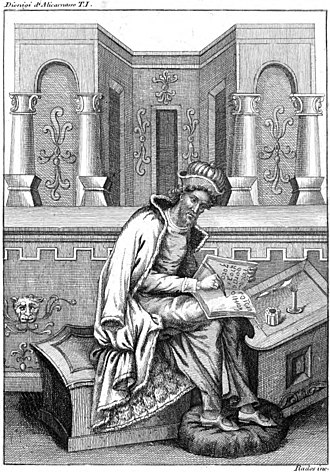
Turning to Greek literature roughly contemporaneous with our New Testament, we find the term malakos in a history of the Roman Empire by Dionysus of Halicarnasus (ca. 60-7 BCE):

The tyrant of Cumae at that time was Aristodemus, the son of Aristocrates, a man of no obscure birth, who was called by the citizens Malacus or “Effeminate” — a nickname which in time came to be better known than his own name — either because when a boy he was effeminate and allowed himself to be treated as a woman, as some relate, or because he was of a mild nature and slow to anger, as others state (Roman Antiquities 7.2.4).

Since Dionysus admits that he is not sure why Aristodemus was nicknamed “Malacus” (“Softie”), this reference is not decisive–though the rumor that Malacus was “treated as a woman” when he was a boy suggests that perhaps malakos had to do with the sexual abuse of boys.

In his discussion of Lev 18 (see Special Laws 3.5–8), the Jewish philosopher Philo of Alexandria (20 B.C.-50 C.E.) uses the term malakia (clearly related to malakos) with reference to pederasty–sex with boys:

And let the man who is devoted to the love of boys [Greek paiderastessubmit to the same punishment, since he pursues that pleasure which is contrary to nature, and since, as far as depends upon him, he would make the cities desolate, and void, and empty of all inhabitants, wasting his power of propagating his species, and moreover, being a guide and teacher of those greatest of all evils, unmanliness and effeminate lust [Greek malakias], stripping young men of the flower of their beauty, and wasting their prime of life in effeminacy (Special Laws 3.7.39).


Robert Gagnon suggests that Paul himself may have coined the word arsenokoitai, with reference to Leviticus 18:22 in the Septuagint–where the Greek words arsenos (“male”) and koite (“bed,” specifically “marriage bed,” hence our word “coitus”) both appear (Robert A. J. Gagnon, The Bible and Homosexual Practice: Texts and Hermeneutics [Nashville: Abingdon, 2001], 312).  If this is so, then Paul may be creating a term here to use for male homosexuality.  In Talmud, however, as in Philo, the infamous Leviticus 18 and 20 passages are read specifically with reference to pederasty (see b. Sanhedrin 54a-55a).

In Greco-Roman society, it was not at all uncommon for an upper-class man to take a boy as his ward, teaching him, enculturating him, introducing him into society–and using him sexually.  The myth of Jupiter and Ganymede, depicted in the plaque above, gave religious sanction to these relationships.  Still, as J. Paul Sampley observes, Roman moral philosophers such as Seneca, Plutarch, and Dio Chrysostom objected to the sexual exploitation of boys (and sometimes girls) enslaved in households for same-sex relations (J. Paul Sampley, “1 Corinthians,” in The New Interpreter’s Bible, Vol 10, ed. Leander Keck [Nashville: Abingdon, 2002], 859).  Perhaps this is what Paul too had in mind in 1 Cor 6:9 when he placed malakoi and arsenokoitai in his vice list, and the Pastor when he placed arsenokoitai in his (1 Tim 1:10).

This does not mean that either Paul or his Jewish contemporaries approved of homosexual behavior; certainly they did not (as Philo’s argument above demonstrates, and as Rom 1:24-27 shows with regard to Paul).  But it does mean that the New Testament vice lists, often used to condemn all same-sex relationships as immoral, are at best ambiguous.  Indeed if, as seems likely,  1 Corinthians 6:9-10 and 1 Timothy 1:9-10 in fact condemn child abuse, then these vice lists have nothing to say about committed, loving relationships between consenting LGBTQ+ adults.

In any case, too many translations of Scripture pretend to a confidence in the meaning of malakoi and arsenokoitai that we actually do not, and cannot, have.  By contrast, while the NRSVue follows the NRSV in rendering malakoi as “male prostitutes,” a textual footnote on the word notes, “Meaning of Gk uncertain.”  Unlike the NRSV, the NRSVue renders arsenokoitai in both passages with appropriate ambiguity, as “men who engage in illicit sex,” and textual footnotes on the word read, again, “Meaning of Gk uncertain.”

As the NRSVue refreshingly acknowledges, we do not know for certain what malakoi  and arsenokoitai mean–and when we do not know what a word means, we ought to in all honestly admit our ignorance.  Like the Sodom story, the story of the Levite’s concubine, or the Old Testament temple prostitution texts, these passages have no relevance to our contemporary conversation about sex and gender.

Mar
2026

Armageddon

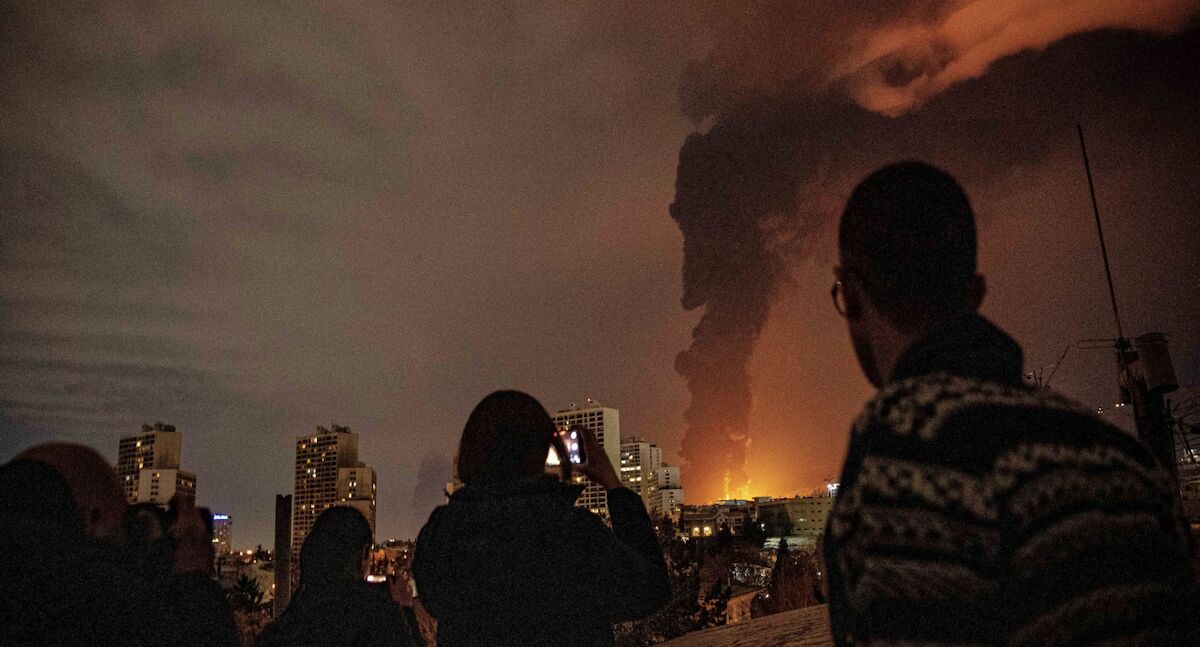
There has been much much to lament about our president’s current war in Iran, from the 175 civilians, many of them children, killed by an American missile strike near an Iranian elementary school, to the seven American soldiers who have died thus far in this conflict.  But last week brought a disturbing issue to light regarding the justification given for this war.

Journalist Jonathan Larsen reported in his substack,

A combat-unit commander told non-commissioned officers at a briefing Monday that the Iran war is part of God’s plan and that Pres. Donald Trump was “anointed by Jesus to light the signal fire in Iran to cause Armageddon and mark his return to Earth,” according to a complaint by a non-commissioned officer.

From Saturday morning through Monday night, more than 110 similar complaints about commanders in every branch of the military had been logged by the Military Religious Freedom Foundation (MRFF).

The complaints came from more than 40 different units spread across at least 30 military installations, the MRFF told me Monday night.

The MRFF is keeping the complainants anonymous to prevent retribution by the Defense Department. The Pentagon did not immediately respond to my request for comment.

One complainant identified themselves as a non-commissioned officer (NCO) in a unit currently outside the Iran combat zone but in Ready-Support status, deployable at any time. The NCO said they were Christian and emailed the MRFF on behalf of 15 troops, including at least 11 Christians, one Muslim, and one Jew. (Full email printed below.)

The NCO wrote to the MRFF that their commander “urged us to tell our troops that this was ‘all part of God’s divine plan’ and he specifically referenced numerous citations out of the Book of Revelation referring to Armageddon and the imminent return of Jesus Christ.”

The fact-checking website Snopes reported that they could neither confirm nor deny this claim, as it is their policy not to rely on anonymous sources.  However, thirty Congressional representatives, including House Armed Services Subcommittee on Military Personnel ranking member Chrissy Houlahan (PA-06) and Congressional Freethought Caucus Co-Chairs Jared Huffman (CA-02) and Jamie Raskin (MD-08), have signed onto a letter to U.S. Department of Defense (DOD) Inspector General Platte B. Moring III requesting an investigation into these reports.  This letter reads in part,

At a time when billions of dollars and untold numbers of lives hang in the balance while the Trump administration wages a war of choice in Iran, the imperative of maintaining strict separation of church and state and protecting the religious freedom of our troops is especially critical. We must ensure that military operations are guided by facts and the law, not end-times prophecy and extreme religious beliefs. . . These allegations are also part of a broader political climate in which Secretary of Defense Pete Hegseth and senior civilian officials have publicly framed Middle East policy in explicitly religious terms.

Secretary Hegseth and these unnamed military commanders are of course free to believe anything that they like regarding the Bible, the endtimes, and alleged prophecies involving war in the Middle East–that is guaranteed by the First Amendment‘s assurances of religious freedom.  They are also free to share those beliefs, in personal conversations, religious services, or Bible studies.  However, it violates the Establishment Clause of that same First Amendment when they impose those beliefs upon others–which is certainly the case when a commanding officer cites those beliefs in a briefing to his subordinates, or when the Secretary “invites” military personnel to religious services and Bible studies at the Pentagon, conducted by “multiple pastors from the Christian nationalist CREC [Communion of Reformed Evangelical Churches] denomination — during working hours, broadcast on the department’s internal TV network, with invitations sent from the Secretary’s office bearing a cross.”

Last month, [Sec. Hegseth] personally invited Doug Wilson — a self-described Christian nationalist and “paleo-Confederate” who co-authored a pamphlet arguing American slavery was “far more benign in practice,” than abolitionists claimed, called the 19th Amendment “a bad idea,” and described his goal as a “Christian republic” in which Congress would publicly confess that Jesus rose from the dead — to preach to an auditorium of military personnel in uniform.

Wilson called the prayer meeting a potential “black swan revival” for American Christianity — the kind of awakening he believes could ultimately bring the nation under Christian governance.

Hegseth thanked him from the stage: “Thank you for your leadership, your mentorship, for the things you’ve started, the truth you’ve told, the willingness to be bold. It’s the type of thing we are trying to exercise here.”

Quite apart from these legitimate concerns about religious freedom, I must also say as a Bible Guy that there is absolutely NO biblical warrant for this obscene justification for the war in Iran.  For the record, Iran is never mentioned in the book of Revelation–or, for that matter, in any of the texts typically trotted out as alleged predictions of the end-time.  There is nothing anywhere in the Bible about a “signal fire in Iran to cause Armageddon and mark [Jesus’] return to Earth.”  That gap, however, is the least of the reasons for questioning this misreading of Scripture.

While advocated today by Evangelical ministers such as our current ambassador to Israel, Rev. Mike Huckabee, and given popular expression in the best-selling “Left Behind” series of novels by Jerry B. Jenkins (based on the notes of  Tim LeHaye), the current strain of end-time expectation in American churches owes most of its assumptions and imagery to Hal Lindsey’s 1970 book The Late Great Planet Earth.  The many predictions in the New Testament that the end of the world would come soon (for example, Mk 13:30; 1 Cor 7:29-31; Rev 22:12, 20) were not mistaken, Lindsey claimed–rather, they were intended for our time. With the re-establishment of the state of Israel, sealed by its “miraculous” victory in the Six Day War, God’s long-paused “prophetic clock” had resumed ticking.  We were now, officially, in the last days.  The countdown to the Rapture, Armageddon, and the Second Coming of Christ had begun.

As I have posted before, as a young Christian, I was among Mr. Lindsey’s most passionate devotees.  I do not quite know how to convey my absolute certitude that the world was about to end.  I never thought that I would grow up, get married, have a family or a career.  I knew–I knew–that at any moment, the sky could roll back like a scroll, as Jesus summoned me and other true believers out of this world and into glory.  I was wrong.  And I must say, I have been delighted to have been wrong!

Yet strangely, neither Mr. Lindsey nor many his followers ever acknowledged that they had been wrong.   With the resumption of God’s prophetic timetable, the end of the world was supposed to come soon: certainly within a generation–say, 40 years. Taking the re-establishment of the state of Israel in 1948 as a starting point, the world should have ended in 1988.  Even if we start the prophetic clock with the Six-Day War in 1967, the end should have come by 2007.  In either case, we are well past the date Lindsey and his followers originally predicted.  The current political state of Israel did not, after all, mark the beginning of the end of time.

But the biggest difficulty with our obsession with alleged prophecies of the end-times is that it has warped our reading of the remainder of the Bible.  Bible scholar J. Richard Middleton writes regarding this pithy cartoon, “I got Man Martin’s permission to use one of his cartoons in my recent book Abraham’s Silence. This one would work well with my earlier book on biblical eschatology, especially on the link between eschatology and ethics.”  And that is precisely the problem.

Russell Moore, the editor-in-chief of Christianity Today magazine, has related a disturbing anecdote

 of having multiple pastors tell me, essentially, the same story about quoting the Sermon on the Mount, parenthetically, in their preaching — “turn the other cheek” — [and] to have someone come up after to say, “Where did you get those liberal talking points?” And what was alarming to me is that in most of these scenarios, when the pastor would say, “I’m literally quoting Jesus Christ,” the response would not be, “I apologize.” The response would be, “Yes, but that doesn’t work anymore. That’s weak.” And when we get to the point where the teachings of Jesus himself are seen as subversive to us, then we’re in a crisis.

Once we have substituted a macho warrior Second-coming Christ for the humble servant Jesus of the Bible, we need no longer listen to the words of Jesus in the Gospels. Since we are about to leave this world anyway, we can without a qualm forsake our God-given responsibility to care for the earth (Genesis 1:26-28).  If we believe that Israel must be re-established out to its ancient borders so that Jesus can come back, we can justify any violence in the region toward that end, whether in Iran, or Lebanon, or Gaza, or the West Bank, ignoring cries for justice (Exod 22:21-24Lev 19:33-34Deut 10:18-19) even from Palestinian Christians. Because the One World Church will be the tool of the Antichrist, we can ignore the plain teaching of Scripture that Christ’s church is called to be one (John 17:20-23), and withdraw into our own private sects.  In short, the approach to the Bible represented by those military commanders cited by the MRFF winds up rejecting the very Bible it claims to revere.


Feb
2026

“And he was transfigured before them”

This Sunday, the last Sunday after Epiphany, is the Feast of the Transfiguration.  The gospel for this day is Matthew 17:1-9 (see the parallels in Mark 9:2-9 and Luke 9:28-36):

Six days later Jesus took Peter, James, and John his brother, and brought them to the top of a very high mountain.  He was transformed in front of them. His face shone like the sun, and his clothes became as white as light.

Moses and Elijah appeared to them, talking with Jesus. Peter reacted to all of this by saying to Jesus, “Lord, it’s good that we’re here. If you want, I’ll make three shrines: one for you, one for Moses, and one for Elijah.”

While he was still speaking, look, a bright cloud overshadowed them. A voice from the cloud said, “This is my Son whom I dearly love. I am very pleased with him. Listen to him!”

Hearing this, the disciples fell on their faces, filled with awe.

 But Jesus came and touched them. “Get up,” he said. “Don’t be afraid.” When they looked up, they saw no one except Jesus.

As they were coming down the mountain, Jesus commanded them, “Don’t tell anybody about the vision until the Human One is raised from the dead.”

This potent and mysterious scene is also full of danger–for us, as for Peter, James, and John, its first witnesses.  This, we want to say, is at last the real Jesus, with his humble peasant disguise stripped away.  Jesus glorified [“transformed” in the CEB, “transfigured” in the KJV and NRSVue]; Jesus the god; Jesus the warrior king, who will surely force this world to follow him–and since we are his earthly representatives after all, that means the world must follow us.  Like Peter, we want to stay on the mountain, to stay with this image of power and glory, which makes us feel powerful, and glorious.

But, no.  The Voice of God from heaven does not endorse either Peter’s grandiose designs, or ours.  There will be no shrines erected here.  Instead, they–and we–are directed to listen to Jesus’ words.  And Jesus forbids them even to talk about this experience, which Matthew calls to orama (“the vision”), “until the Human One [NRSVue, like KJV, reads “the Son of Man”] is raised from the dead” (Matt 17:9).  In other words, we cannot understand what the vision means apart from  Jesus’ crucifixion and resurrection.

After this revelation of his glory, Jesus leads them–and us–off of the mountain and back into the world, for only there will we discover who Jesus truly is.  After all, Jesus was not God sometimes (say, on the Mount of Transfiguration) and human sometimes (say, in the manger–or on the cross).  Certainly, Jesus’ humanity was not a disguise; he was not God pretending to be human, God in a people mask.  Nor was he a charlatan–a human pretending to be a god.  Jesus was, always and everywhere, himself.  So, yes: the Jesus they saw every day–laughing, crying, hungry, angry, dusty and weary from the road, Jesus in all his fleshiness–was indeed the real Jesus.  They could not always see his glory, but his glory was always present, and inseparable from his humanity–indeed, from his suffering.

Consider the image of the returning, glorified Jesus in Revelation 19:11–16:

Then I saw heaven opened, and there was a white horse. Its rider was called Faithful and True, and he judges and makes war justly. His eyes were like a fiery flame, and on his head were many royal crowns. He has a name written on him that no one knows but he himself.  He wore a robe dyed with blood, and his name was called the Word of God. Heaven’s armies, wearing fine linen that was white and pure, were following him on white horses. From his mouth comes a sharp sword that he will use to strike down the nations. He is the one who will rule them with an iron rod. And he is the one who will trample the winepress of the Almighty God’s passionate anger. He has a name written on his robe and on his thigh: King of kings and Lord of lords.

Notice that, in this passage, King Jesus’s robe is already stained with blood when he begins to descend from heaven (Rev. 19:13), so the blood cannot belong to his earthly enemies. So, whose blood is it? Given that the most common image for Christ in Revelation is the Lamb who was slain (twenty-six times; for example, Rev 5:6, 12; 12:11; 13:8), it seems that the blood staining his robes is his own! Further, the only weapon he bears is the sword that comes from his mouth, that is, his word (Rev. 19:15; see also Rev. 1:16; 2:16; Heb. 4:12; Eph. 6:17). The Old Testament imagery of the Divine Warrior to which John’s vision alludes (Isa. 63:1–3; Ps. 2:9) is transformed by the realization that the rider on the white horse is the one called The Word of God (Rev. 19:13), whose robe is stained with his own innocent blood, and who strikes down the nations by the power of his transforming Word (remember the command of the Voice on the mountain, that we listen to him!)–including the words of his Sermon on the Mount, and their rejection of violence (Matt. 5:38–48)!

Speaker of the House Mike Johnson, R-La., gestures as he meets with reporters ahead of a key procedural vote to end the partial government shutdown, at the Capitol in Washington, Tuesday, Feb. 3, 2026. (AP Photo/J. Scott Applewhite)


To turn to a contemporary example: recently, Speaker of the House Mike Johnson critiqued Pope Leo XIV’s call for kindness and respect for the immigrant on what he imagined to be biblical grounds.  Referring to Romans 13:1-2, the Speaker insisted that Christians must submit to the authority of the state, specifically with regard to borders, and concluded,

When someone comes into your country, comes into your nation, they do not have the right to change its laws or to change a society. They’re expected to assimilate. We haven’t had a lot of that going on.”

There is much that could be said in response to this contextless misreading of Scripture (for example, that Paul himself would be repeatedly arrested and ultimately executed for refusing to submit to Roman authority).  But perhaps the best response I have seen comes from Episcopal priest Michael DeLashmutt, who insists that we read this passage in terms of power and powerlessness:

Paul is writing to fragile house churches living under imperial surveillance, not to Christians wielding state power, and his concern is pastoral and pragmatic: how believers survive under empire without inviting unnecessary repression. It is not a blueprint for Christian governance, nor a timeless endorsement of every policy enacted in the name of law and order.

To lift Romans wholesale into a contemporary political theology — particularly one that treats the state as the primary moral agent — is to ask the text to bear more weight than it can sustain. Romans (along with the rest of Christian Scripture) must be read alongside Israel’s long experience of exile, Jesus’ execution by the state and the New Testament’s recurring suspicion of imperial power. The Bible offers no simple equation between God’s purposes and the interests of any given government, even one that claims Christian privilege.

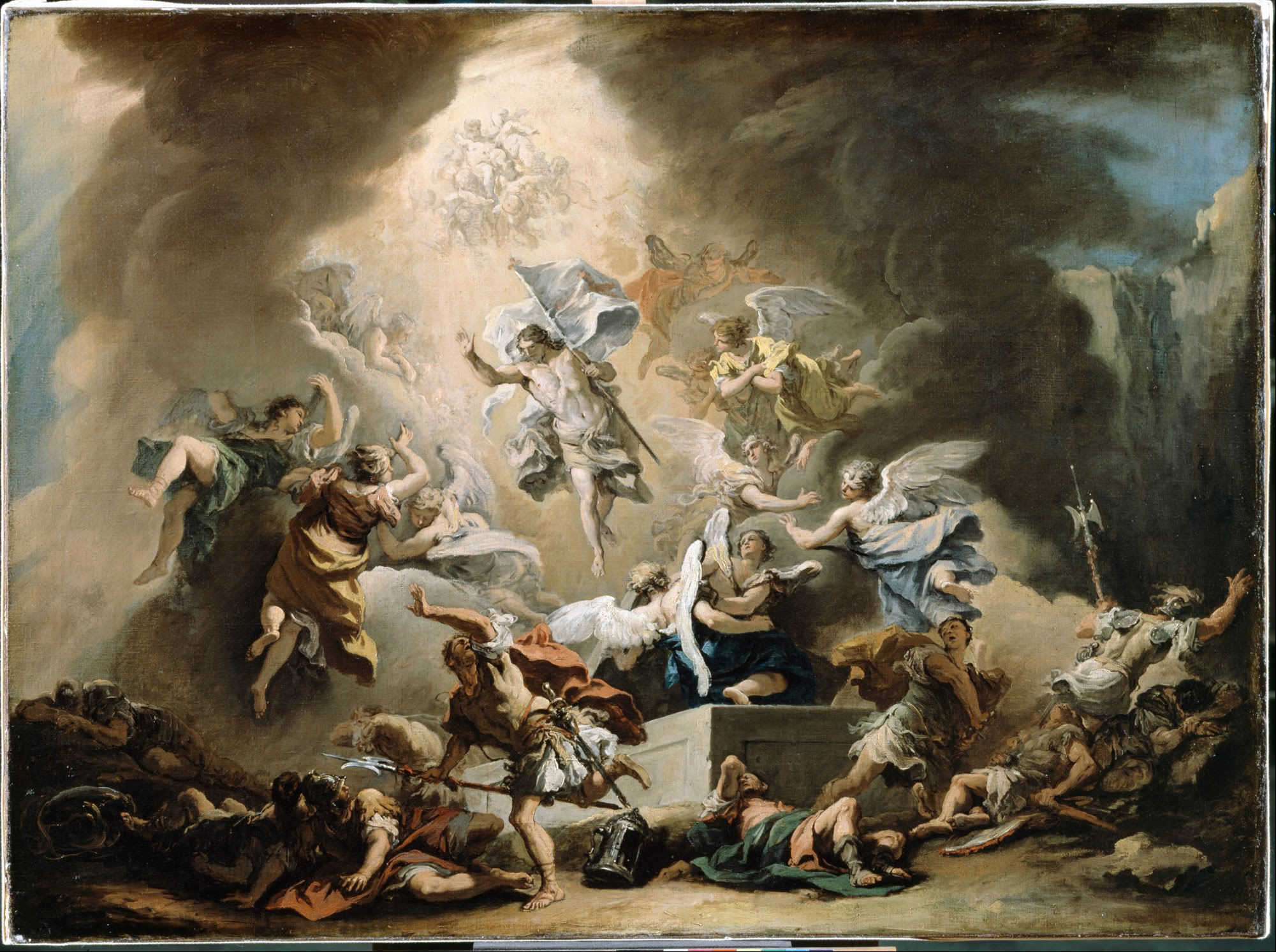
In the face of the current American heresies of Christian nationalism and Dominionism—the claim that Evangelical Christians ought to impose their faith and morality through political power—it is vital that, as Jesus insists, we view his Transfiguration through his Cross. Otherwise, the image of Christ glorified too readily becomes an excuse for our own claims to political dominance, and a justification for violence against those outside our small circle.

Next week, with Ash Wednesday, Lent begins.  Friends, let us follow Jesus off the mountain and into the wilderness, and learn from him in his weakness what strength truly means.  This prayer for Transfiguration Sunday (from Revised Common Lectionary Prayers, © 2002 Consultation on Common Texts [Augsburg Fortress]) invites us to ask God for a transfiguration of our own:

Holy God, mighty and immortal,
you are beyond our knowing,
yet we see your glory in the face of Jesus Christ,
whose compassion illumines the world.
Transform us into the likeness of the love of Christ,
who renewed our humanity so that we may share in his divinity,
through the same Jesus Christ, our Lord,
who lives and reigns with you and the Holy Spirit. Amen.

AFTERWORD

The stained glass at the head of this post is a detail showing the Transfiguration from “Kingdom of God” (2005), by George Walsh: the South Transept Window of the Church of the Most Holy Rosary in Tullow, Ireland. From Art in the Christian Tradition, a project of the Vanderbilt Divinity Library, Nashville, TN.


Jan
2026

Wise Men, or Magi?

In this season after Epiphany (in the Christian West, January 6–the first day after the twelve days of Christmastide), I have been thinking about the translation of Matthew 2:1-12, and especially, about its opening verses:

After Jesus was born in Bethlehem in the territory of Judea during the rule of King Herod, magi came from the east to Jerusalem. They asked, “Where is the newborn king of the Jews? We’ve seen his star in the east, and we’ve come to honor him” (Matt 2:1-2, CEB).

In the CEB and the NIV, Jesus’ foreign visitors are called “magi.”  Likewise, in the newly updated edition of the NRSV, one of the 12,000 substantive changes made to that translation was changing the NRSV’s “wise men” to “magi.”  The old NRSV had left the translation “wise men” in place from its predecessor, the RSV, which had taken the rendering over from the old King James Version–part of the RSV’s commitment to preserve the familiar rhythms and language of the KJV as much as possible “in the light of our present knowledge of the Hebrew and Greek texts and their meaning on the one hand, and our present understanding of English on the other” (from the preface to the RSV).

Unquestionably, “magi” is more accurate and specific than “wise men.”  The Greek text has magoi (singular magos), a loan word from Old Persian, where it describes a clan of Zoroastrian priests and astrologers.  The word appears six times in our New Testament: four, all plural, in Matthew’s Christmas story (Matt 2:1, 7, 16 [two times]) and twice in the singular for the sorcerer Bar-Jesus (also called Elymas), an adversary of Paul and Barnabas who was stricken blind by the apostle (Acts 13:6, 8).

Evidently related to magos are the Greek noun mageia (“magic”) and verb mageuo (“practice magic”), found only once each in our New Testament; both are used for Simon (called in later tradition Simon Magus), a Samaritan magician converted under Philip, who is harshly rebuked for trying to buy the gifts of miracles and healing from Peter (Acts 8:9, 11).  Our English words “magic” and “magician” likewise come from this Old Persian root, by way of Greek and Latin (it is the Latin Vulgate which renders magoi as magi.)

The CEB and the NIV alike use modern colloquial English: the NIV assumes a high school reading level, while the CEB is aimed at a seventh grade reading level.  So, their decision to use “magi” is an interesting one.  Evidently, those translators believed that most modern readers would have no trouble identifying who the Magi are.  Certainly, “magi” has entered into broad English usage, specifically for Jesus’ foreign visitors.

Consider O. Henry’s famous short story for the Christmas season, “The Gift of the Magi,” in which a poor couple each sell the most precious thing they own to buy a gift for the other: he, his pocket watch to buy combs for her hair; she, her hair, to buy him a golden watch chain.  The story concludes:

The magi, as you know, were wise men—wonderfully wise men— who brought gifts to the newborn Christ-child. They were the first to give Christmas gifts. Being wise, their gifts were doubtless wise ones. And here I have told you the story of two children who were not wise. Each sold the most valuable thing he owned in order to buy a gift for the other. But let me speak a last word to the wise of these days: Of all who give gifts, these two were the most wise. Of all who give and receive gifts, such as they are the most wise. Everywhere they are the wise ones. They are the magi.

As O. Henry reminds us, in the KJV of Matthew 2, the Magi are called “wise men”–which is, frankly, a bit odd.  Generally, those 1611 translators followed the Vulgate in such matters.  For example, they follow the Vulgate’s lead in leaving the Aramaic words mammon and maranatha untranslated.  So too, in Luke 23:33, where the place Jesus was crucified is called Kranion (Greek for “skull;” the other gospels use Golgotha, Aramaic for “skull;” see Matt 27:33; Mark 15:22; John 19:17), the KJV follows the Vulgate Calvariae (Latin for “skull”), and famously calls the place “Calvary.”  So, why did the King James translators break with the Vulgate regarding the Magi?

I became curious as to how widespread English usage of “magi” was, and how far back it goes.  According to the Oxford English Dictionary, the answer is fairly wide, and pretty early!  In his “House of Fame” (1384), Geoffrey Chaucer’s satiric dream visions, he describes, in the same context as famous musicians and entertainers, famous witches and magicians,

And clerkes eke, which konne wel

Alle this magik naturel (House of Fame 3.1265-66)

Among such famous fakers, Chaucer saw “eke Symon Magus” (“House of Fame” 3.1274; see Acts 8)!

From 1638–not that long after the 1611 translation of the KJV–come Sir Thomas Herbert’s discouraging words regarding magi:

Let me rather busie my brains in quest of what a Magus was. . . under which Title, many Witches, Sorcerers. . . and Diaboliques have cloakt their trumperies (Travels in Persia, 214).

In contrast, the OED lists numerous attempts to distance the biblical Magi from the disreputable magus.  From Three Kings of Cologne, a 15th century Middle English translation of John of Hildesheim’s Historia Trium Regum comes Seynte Austyn’s view that “Magi in the tung of Chaldee is as moche to seye as a Philosophre.”  William Langland’s Piers Plowman (1377) declares that “Wherfore and whi wise men that tyme, Maitre and lettred men Magy hem called.”  So there was precedent both for a reluctance about associating the visitors to the Christ child with sorcerers, and for the translation, “wise men,” that King James’ translators chose to use. Intriguingly, the Roman Catholic Douay-Rheims translation of the Vulgate into English (the American 1899 edition, which relies on Bishop Richard Challoner’s mid-eighteenth century revision to the seventeenth century original) also renders magi as “wise men.”

Of course, tradition says that there were three Magi, that they were kings from three continents and three races, and that they were named Caspar, Melchior, and Balthasar–hence John of Hildesheim’s History of the Three Kings (1370).  The Middle English translation’s title refers to the traditional location of the bones of the three kings, in an opulent shrine in Cologne, Germany built to house these relics (collected, as so many were, by Constantine’s mother Helena).


None of this, of course, is found in Matthew’s account.  Matthew does not tell us how many Magi came–the traditional number three comes from their three gifts: gold, frankincense, and myrrh (Matt 2:11-12). The idea that they were kings from distant lands and races comes from Isaiah 60:1-6, traditionally read as fulfilled in the visit of the Magi:

Nations will come to your light
    and kings to your dawning radiance.

. . . the nations’ wealth will come to you.
 Countless camels will cover your land,
    young camels from Midian and Ephah.
They will all come from Sheba,
    carrying gold and incense,
    proclaiming the Lord’s praises.


Still, there is an appropriateness to the tradition’s reading of the Magi as representing the whole outside world.  After all, they come to baby Jesus as the ultimate outsiders.  They come not only from outside of Judea, but from outside the Roman empire itself–from the land of the feared Parthians, an armed and unstable threat on the empire’s eastern frontier. They are not Jews, either ethnically or religiously; while nothing is said of their religious heritage by Matthew, they would have been Zoroastrians.  Yet it is Matthew who tells their story: Matthew, the most Jewish of the gospel writers, is the one who records a visit to the Christ child from foreigners and unbelievers, who come, not as enemies to threaten the Child, but as pilgrims to honor him.

Herod’s religious experts also see the Magi’s star, and rightly interpret the Scriptures that witness to the coming king:

As for you, Bethlehem of Ephrathah,
    though you are the least significant of Judah’s forces,
        one who is to be a ruler in Israel on my behalf will come out from you.
    His origin is from remote times, from ancient days.
 Therefore, he will give them up
        until the time when she who is in labor gives birth.
        The rest of his kin will return to the people of Israel.
He will stand and shepherd his flock in the strength of the Lord,
        in the majesty of the name of the Lord his God.
        They will dwell secure,
        because he will surely become great throughout the earth;
        he will become one of peace (Micah 5:2-5; see Matt 2:4-6)

But these faithful, patriotic citizens stay in the false security of Herod’s walled palace, and never see the miracle.  Instead, in Matthew it is the foreign Magi who become the first, faithful witnesses to the new thing God is doing–breaking into our world as one us in Bethlehem.

Title: Star of Bethlehem with Pomegranate Trees [Click for larger image view]

Epiphany celebrates the light of God shining into the entire world with the birth of Christ, and indeed, the light of God’s revelation shining into all our lives yesterday, today, and forever!  May we learn from the wise men to be “wise guys” ourselves: to be ready to receive God’s blessing from the hands, and to hear God’s word in the voice, of a stranger.  May we say to all hatred, racism, and fearmongering a firm and unequivocal “No.”

AFTERWORD:

The photo of the Three Kings reliquary is from astropelusa / Atlas Obscura User.  The quilt above, “Star of Bethlehem With Pomegranate Trees,” was made by an anonymous quilter in 1850, and is at the Museum of Fine Arts in Boston.  This image comes from Art in the Christian Tradition, a project of the Vanderbilt Divinity Library, Nashville, TN. https://diglib.library.vanderbilt.edu/act-imagelink.pl?RC=56278 [retrieved January 30, 2023]. Original source: https://commons.wikimedia.org/wiki/File:Star_of_Bethlehem_with_Pomegranate_Trees,_New_York,_c._1850_-_Museum_of_Fine_Arts,_Boston_-_DSC02710.JPG.


Dec
2025

Merry Christmas!

This year, St. Paul’s minister of music Dr. Mark A. Boyle led us in a Christmas Cantata by David von Kampen, setting texts by Paul Gerhardt (1607-1676), as well as selected passages of Scripture.  It was the best expression of the meaning and power of Christ’s Incarnation that I have encountered.  I am sharing here the words of that cantata as my Christmas greeting to all.  God bless you, friends–and Merry Christmas!

MOVEMENT 1:  “Oh Jesus Christ, Thy Manger Is”

O Jesus Christ, Thy manger is

My Paradise, at which my soul reclineth.

For there, O Lord, Doth lie the Word of God made flesh for us;

Here-in Thy grace forth shineth

Image result for nativity icon

MOVEMENT 2: “A Great Light”

The people that walked in darkness have seen a great light:

they that dwell in the land of the shadow of death,

upon them hath the light shined.

For unto us a child is born,

unto us a son is given: and the government shall be upon his shoulder:

and his name shall be called Wonderful,

Counsellor, The mighty God,

The everlasting Father,

The Prince of Peace (Isaiah 9:2, 6 KJV).

MOVEMENT 3: “He Whom the Wind and Sea Obey”

He whom the sea and wind obey

Doth come to serve the sinner in great meekness.

Thou God’s own Son, with us are one,

Dost join us and our children in our weakness.

MOVEMENT 4: “The Word was Made Flesh”

And the Word was made flesh,

and dwelt among us,

and we beheld his glory,

the glory as of the only begotten of the Father,

full of grace and truth.

MOVEMENT 5: “How Greatly God Must Love Thee”

Thou Christian heart, Whoe’er thou art,

Be of good cheer and let no sorrow move thee!

For God’s own Child, In mercy mild,

Joins thee to Him; How greatly God must love thee!

The world may hold Her wealth and gold;

But thou, my heart, keep Christ as thy true treasure.

To Him hold fast, Until at last

A crown be thine and honor in full measure.

AFTERWORD:  You may better know hymnist Paul Gerhardt for his translation from Latin of “O Sacred Head Now Wounded” (No. 286 in the United Methodist Hymnal).  John Wesley himself translated some of Gerhardt’s hymns from their German originals (for example, “Give to the Winds Thy Fears,” No. 129; and “Jesu, Thy Boundless Love to Me,” No. 183).  If you care to hear our choir’s presentation of the von Kampen cantata in worship, you can watch and listen here.

Dec
2025

The Peaceable Kingdom


While Edward Hicks’ name may be unfamiliar to you, I’m betting you will immediately recognize his work. From 1820 until his death in 1849, this Quaker preacher and American folk artist painted the same scene over and over again—perhaps as many as a hundred times, although only sixty-two pictures survive.  Likely you have seen at least one of them; the one depicted above is in the Carnegie Museum of Art in Pittsburgh.

In each painting, little children stand solemn, unmenaced, and unafraid among lions, wolves, and bears, accompanied by equally unfazed sheep and cattle. Each face, human and animal, gazes calmly out of the canvas, meeting our eyes in serene invitation. To each painting, Hicks gave the same title: “The Peaceable Kingdom.”

Hicks drew this imagery from Isaiah (Isa. 11:1–10; 65:17–25):

The wolf will live with the lamb,
    and the leopard will lie down with the young goat;
    the calf and the young lion will feed together,
    and a little child will lead them.
The cow and the bear will graze.
    Their young will lie down together,
    and a lion will eat straw like an ox.
A nursing child will play over the snake’s hole;
    toddlers will reach right over the serpent’s den (Isa. 11:6-8; compare 65:25).

But Isaiahs vision is likely drawn in turn from the peaceful, ordered world depicted in the first of the two Genesis accounts of creation, Genesis 1:1–2:4a, in which there are neither predators nor prey:


Then God said, “I now give to you all the plants on the earth that yield seeds and all the trees whose fruit produces its seeds within it. These will be your food. To all wildlife, to all the birds in the sky, and to everything crawling on the ground—to everything that breathes—I give all the green grasses for food.” And that’s what happened (Gen. 1:29–30).


Of course, neither of these passages look like the world in which we live!  Both the world as it one day would be in Isaiah’s prophecy, and the world as it once was in Genesis, are Gegenwelten: imagined ideal counterworlds of calm and perfect order. In this dream of life as it should be, once was, and will be again, God’s world is a peaceable kingdom, where bloodshed and violence play no role.

Often, as in the painting in Pittsburgh’s Carnegie Museum, Hicks included in the background of his “Peaceable Kingdom” paintings William Penn making a treaty with the Lenni Lenape Indians in 1682 (see the detail above). But why?  What does this have to do with Isaiah’s vision of the peaceable kingdom?  To answer that question, we need to look more closely at Isaiah 11:1-10: the Hebrew Bible reading for this second week of Advent.

Likely, this passage comes from the mid-8th century BCE: after the depredations of the Syro-Ephraimite War in Judah, and the fall of Israel and deportation of its people (722 BCE; see Isa 7–8).  In the wake of these tragedies, Isaiah describes his people and their leadership as a tree chopped down to the ground.  But, the prophet declares, there is still life in the stump!

A shoot will grow up from the stump of Jesse;
    a branch will sprout from his roots (Isa 11:1).

Image result for Isaiah sistine

Isaiah’s vision of Judah’s resuscitation is also a vision of the renewal of kingship. Jesse was the father of David, ancestor of Judah’s kings (see Ruth 4:17–22).  This passage sets forth the prophet’s hope for just rule: his idealistic vision of what the king should be, and one day would be;

The LORD’s spirit will rest upon him,
    a spirit of wisdom and understanding,
    a spirit of planning and strength,
    a spirit of knowledge and fear of the LORD.
He will delight in fearing the LORD.
He won’t judge by appearances,
    nor decide by hearsay.
He will judge the needy with righteousness,
    and decide with equity for those who suffer in the land.
He will strike the violent with the rod of his mouth;
    by the breath of his lips he will kill the wicked.
Righteousness will be the belt around his hips,
    and faithfulness the belt around his waist (Isa 11:2–5).

For Isaiah, just government in the social realm reflects divine order in the natural realm (see Psalm 19), and so he dreams of a world in which (as in Genesis 1:1–2:4a!) nature reflects God’s intent for creation perfectly.  Although his vision comes from a time of devastation and despair, for Isaiah despair always yields to hope; God’s judgment is always tempered by God’s mercy.

The last verse of this passage looks out to the nations–as the Quaker painter realized:

On that day, the root of Jesse will stand as a signal to the peoples. The nations will seek him out, and his dwelling will be glorious (Isa 11:10).

That is why Hicks places William Penn and the Lenni Lenape in his depiction of Isaiah’s peaceable kingdom.  God’s peace and justice are not the property of any one nation or race, but are given to unite the whole world.  Further, Hicks believed that Isaiah’s vision was more than a dream for someday. He saw the treaty with the Lenni Lenape as evidence that God was already at work in the world, bringing God’s peace and justice to fruition here and now.  Hicks heard that hope in the account of Isaiah’s vision.


Image result for Paul rembrandt

Paul heard it, too! For this apostle to the Gentiles, Isaiah’s vision demonstrated that God’s grace extends beyond the borders of Israel.  In the epistle for this Sunday (Romans 15:4-13), Paul quotes Isaiah 11:10 (it sounds a bit different, as he is quoting from the Septuagint, the Greek translation of that passage):

 And again, Isaiah says,

There will be a root of Jesse,
    who will also rise to rule the Gentiles.
The Gentiles will place their hope in him (Rom 15:12).

For Paul, of course, the branch from the root of Jesse is Jesus, who has fulfilled Isaiah’s dreams of what a king should be, and who comes, as Isaiah envisioned,  to all peoples.

Romans is an unusual epistle.  Usually, Paul wrote to churches he had established himself or had already visited, responding directly to the circumstances and concerns of each particular community.  But at the time he wrote to the Romans, Paul had never been to Rome (see Rom 1:8-15). Why then did he write this letter, to people he had never met?

New Testament scholar Robert Jewett proposes that Paul wrote Romans as an ambassador for Christ, seeking to reconcile the estranged gentile (non-Jewish) and Jewish Christian communities in Rome.  So, Paul begins by asserting his confidence that Jesus has come to and for Jew and Gentile alike: 

I’m not ashamed of the gospel: it is God’s own power for salvation to all who have faith in God, to the Jew first and also to the Greek (Rom 1:16)

He returns to this theme in Sunday’s epistle:

So welcome each other, in the same way that Christ also welcomed you, for God’s glory. I’m saying that Christ became a servant of those who are circumcised for the sake of God’s truth, in order to confirm the promises given to the ancestors, and so that the Gentiles could glorify God for his mercy (Rom 15:7-9).

Paul is persuaded that the Gospel is for all people:

May the God of endurance and encouragement give you the same attitude toward each other, similar to Christ Jesus’ attitude. That way you can glorify the God and Father of our Lord Jesus Christ together with one voice (Rom 15:5-6).


Echoing Paul’s call to unity and inclusion,  Jurgen Moltmann, who died last year at 98, warned Christians not to be seduced by nationalism:

The church of Christ is present in all the people on earth and cannot become ‘a national religion’. The church of Christ ecumenically embraces the whole inhabited earth. She is not a tribal religion, nor a Western religion, nor a white religion, but the church of all humanity. The church of Christ is not national, but it is a church of all the nations and humanity.

Moltmann’s warning came from grim experience. His famous theology of hope had its beginnings when he was a German POW in England, having seen first-hand in Nazi Germany the destructive consequences of a church allied with a state defined by exclusion.


Image result for baptism of jesus icon
In the Gospel for this second Sunday of Advent (Matthew 3:1-12), our attention is drawn to John the Baptist, the forerunner of the Christ, who famously baptized all comers: all who repented of their sins. The gospel is not the property of any nation, or race, or group, but is given to the whole world.  To the religious leaders, so proud of their distinct heritage, John issued this warning:

Produce fruit that shows you have changed your hearts and lives.  And don’t even think about saying to yourselves, Abraham is our father. I tell you that God is able to raise up Abraham’s children from these stones.  The ax is already at the root of the trees. Therefore, every tree that doesn’t produce good fruit will be chopped down and tossed into the fire (Matt. 3:8–10).

John’s fiery denunciation of those who had thought themselves to be beyond reproach, and his summons to righteous action, may seem a strange fit with Paul and Isaiah’s visions of peace and hope–but remember William Penn in the corner of Hicks’ painting!  In Isaiah 11, the peaceable kingdom follows a depiction of just and wise rule (Isa. 11:1–5). Jesus taught us to pray for God’s kingdom, and for the realization of God’s good will “on earth as it’s done in heaven” (Matt 6:9-13)–that is, not just someday, but today.  As the rabbis say, we are called to tikkun ‘olam: the healing of the world.  But the healing of our world cannot be accomplished apart from repentance, followed by concerted, political action. Our choices matter, friends, for good or for ill.

AFTERWORD:

Thanks to St. Paul’s friend Carolyn Kelley Evans, a docent at the Carnegie Museum of Art in Pittsburgh, for letting me know that the picture I originally shared was not the version of Hicks’ “Peaceable Kingdom” in that museum after all, and for sharing with me an image of the actual painting, on view in Gallery 17.  That error is now corrected!


Nov
2025

A Thanksgiving Prayer

30 Scripture Verses to Celebrate Thanksgiving with an Attitude of Grat - Clothed with Truth

FOREWORD: In 2021, my friend, former student, and colleague in ministry Karen Slusser led our congregation at St. Paul’s UMC in this beautiful thanksgiving litany, from poet, theologian, and civil rights activist Howard Thurman.  I share it with you for your own meditation and devotion this festive week.  God bless you, friends–Happy Thanksgiving!

Who Was Howard Thurman? | BU Today | Boston University

Howard Thurman’s Thanksgiving Prayer

Today, I make my Sacrament of Thanksgiving.
I begin with the simple things of my days:
Fresh air to breathe,
Cool water to drink,
The taste of food,
The protection of houses and clothes,
The comforts of home.
For all these I make an act of Thanksgiving this day!

I bring to mind all the warmth of humankind that I have known:
My mother’s arms,
The strength of my father
The playmates of my childhood,
The wonderful stories brought to me from the lives
Of many who talked of days gone by when fairies
And giants and all kinds of magic held sway;
The tears I have shed, the tears I have seen;
The excitement of laughter and the twinkle in the
Eye with its reminder that life is good.
For all these I make an act of Thanksgiving this day

I finger one by one the messages of hope that awaited me at the crossroads:
The smile of approval from those who held in their hands the reins of my security;
The tightening of the grip in a simple handshake when I
Feared the step before me in darkness;
The whisper in my heart when the temptation was fiercest
And the claims of appetite were not to be denied;
The crucial word said, the simple sentence from an open
Page when my decision hung in the balance.
For all these I make an act of Thanksgiving this day.

If John Wesley Came to General Conference – Part 1 - United Methodist Insight

I pass before me the main springs of my heritage:
The fruits of labors of countless generations who lived before me,
Without whom my own life would have no meaning;
The seers who saw visions and dreamed dreams;
The prophets who sensed a truth greater than the mind could grasp
And whose words would only find fulfillment
In the years which they would never see;
The workers whose sweat has watered the trees,
The leaves of which are for the healing of the nations;
The pilgrims who set their sails for lands beyond all horizons,
Whose courage made paths into new worlds and far off places;
The saviors whose blood was shed with a recklessness that only a dream
Could inspire and God could command.
For all this I make an act of Thanksgiving this day.


I linger over the meaning of my own life and the commitment
To which I give the loyalty of my heart and mind:
The little purposes in which I have shared my loves,
My desires, my gifts;
The restlessness which bottoms all I do with its stark insistence
That I have never done my best, I have never dared
To reach for the highest;

The big hope that never quite deserts me, that I and my kind
Will study war no more, that love and tenderness and all the
inner graces of Almighty affection will cover the life of the
children of God as the waters cover the sea.

All these and more than mind can think and heart can feel,
I make as my sacrament of Thanksgiving to Thee,
Our Father, in humbleness of mind and simplicity of heart.

AFTERWORD:

Howard Thurman, 1899–1981 (from Rich Barlow, “Who Was Howard Thurman?”, Boston University Today, January 7, 2020)

“In 1944, Thurman cofounded San Francisco’s Church for the Fellowship of All Peoples, the first integrated interfaith religious congregation in the United States. In 1953, he became the dean of Marsh Chapel, the first black dean at a mostly white American university, mentoring, among many others, Martin Luther King, Jr. (GRS’55, Hon.’59) as he developed his philosophy of nonviolence.

Yet Thurman didn’t live the dramatic public activism of King or suffer a similar martyrdom. In fact, critics called him a backbencher in the Civil Rights Movement, more preoccupied with mystical meanderings than frontline protesting. Thurman countered that the first order of social change was changing one’s individual internal spirit. ‘He rather gently and powerfully moved through the world in a spirit of grace, dignity, and humility,’ says Walter Fluker (GRS’88), the School of Theology Martin Luther King, Jr., Professor of Ethical Leadership, who published Thurman’s papers, taught a seminar on the man last semester, and wrote his dissertation on Thurman and King.

Who exactly was Howard Thurman?

In an interview shortly before his death, Thurman said he caught the ‘contagion’ of religion from his grandmother, who cared for him after his father died when Thurman was seven and his mother became the family breadwinner. His grandmother recited for Howard the mantra of the black preacher she’d heard as a child on her owner’s plantation: ‘You are not slaves. You are not niggers. You’re God’s children!’ His grandmother’s charismatic rendition, Thurman told the interviewer, inspired in him the belief that ‘the creator of existence also created me.’

That belief took him to Morehouse College in Atlanta, then to seminary and a series of jobs as pastor and professor. His first pastorate after his 1925 ordination as a Baptist minister, in Ohio in the 1920s, led to study with Quaker pacifist Rufus Jones, which Thurman said changed his life. His thinking was honed by a 1935 trip to India with other African Americans to meet Mohandas Gandhi, who completed Thurman’s conversion to nonviolent social activism.

Thurman’s association with Martin Luther King, Jr., predated BU. Thurman and King’s father, an Atlanta minister, were friends when the young King was growing up. ‘Thurman was at the King home many times,’ says Vita Paladino (MET’79, SSW’93), former director of the Howard Gotlieb Archival Research Center, which houses King’s donated papers. Their BU time overlapped for only a year, and King considered his father and Thurman a different, older generation, Paladino says. Nonetheless, King carried Jesus and the Disinherited, Thurman’s most important book, while leading the 1955–56 Montgomery bus boycott.

Published in 1949, the book argues that Jesus taught the oppressed a faith-based unconditional love that would enable them to endure their oppression. Thurman’s message moved not only King, but Jesse Jackson, who in 1982 penned an essay for a postmortem tribute to Thurman by BU. Jackson the activist wrote that he’d been drawn to Thurman the academic by his insistence that ‘if you ever developed a cultivated will with spiritual discipline, the flame of freedom would never perish.’”